
The current COVID-19 pandemic is unlike anything our society has faced in recent times. With significant loss to life and economy how bad is it if we compare it to the nearest crisis – the 2008 financial crisis. With unemployment at historic high, many analyst have commented that US economy maybe well under recession and it could possibly even slip into Depression if current COVID situation does not improve.
So first lets understand the difference between Recession and Depression.
Recession Vs Depression:
Recession: In economics, a recession is a business cycle contraction when there is a general decline in economic activity. Recessions generally occur when there is a widespread drop in spending (an adverse demand shock). In US, as a thumb rule recession is defined as two consecutive quarters of negative GDP growth (Source: Wikipedia)
Depression: In economics, a depression is a sustained, long-term downturn in economic activity in one or more economies. It is a more severe economic downturn than a recession, which is a slowdown in economic activity over the course of a normal business cycle. One of the proposed definition of depression includes two general rules:
1. a decline in real GDP exceeding 10% or
2. a recession lasting 2 or more years
(source: Wikipedia)
The US government took some swift action in announcing an unprecedented $2 Trillion CARES package (Coronavirus Aid, Relief and Economic Security Act) which was signed into law by President Donald Trump on March 27, 2020. But in its fight to limit CVOID-19 spread, large swaths of business were shutdown in US leading to sharp rise in unemployment. But how does the pace and intensity of unemployment under COVID compare to 2008 financial crisis?
One point to remember though is that COVID-19 is a Public Health Crisis which has affected most of the world population (and US as well) all at the same time. While the 2008 financial crisis had its root in financial and banking sector which then spread to other sectors and the ultimate fallout was beyond US, impacting financial markets in Europe and Asia. But 2008 financial crisis is essentially a man-made crisis.
A Look at the US unemployment trend
COVID-19 Timeline:
Dec 31: Initial cases treated in Wuhan, China
Jan 20: Other countries, including US confirmed cases
Jan 30: W.H.O. declares global health emergency
Feb 28: Infection spiked in Europe
Mar 13: Pres. Trump declares National Emergency
Mar 26/27: US hardest hit by pandemic. Pres. Trump signed stimulus bill into law
Mar 30: More states issued stay-at-home directive
Source: US Bureau of Labor Statistics, NYTimes.com
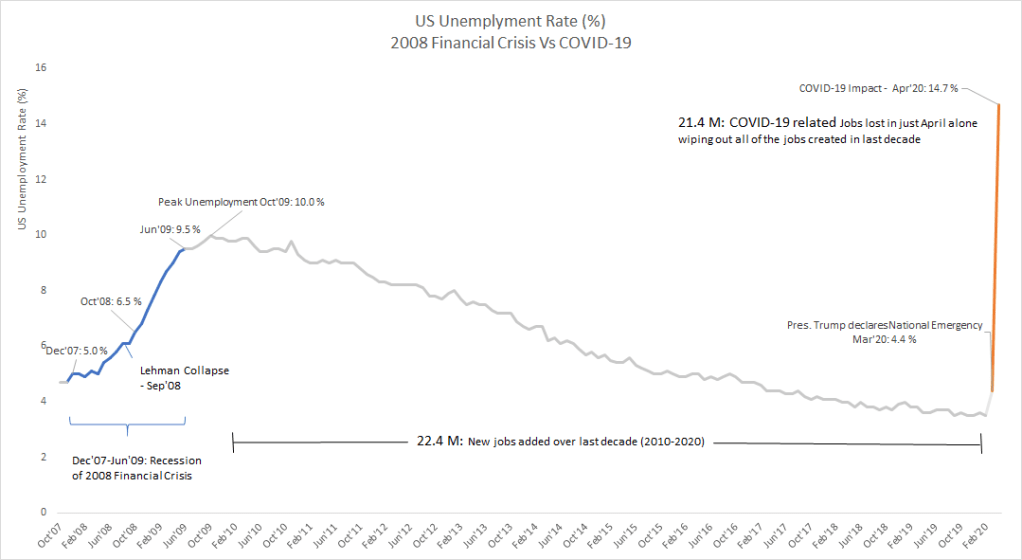
As can be seen from the chart above, the 2008 Financial recession started in Dec-07 at 5% unemployment rate and the recession officially ended about 17 months later on Jun-09 at 9.5% unemployment rate. Interestingly, the unemployment continued to rise even after recession ended, peaking out at 10% unemployment rate in Oct’09. The unemployment declined gradually thereafter. It took about 6.5 years for the unemployment rate to reach Pre-2008 financial crisis level which happened on Nov-16 at 4.7% unemployment rate.
As the Coronavirus spread rapidly through US, the US economy had to be put under a medically induced coma by shutting down large swaths of economy to reduce spread of infection. The unemployment rate sky-rocketed to 14.7% in a single largest jump, unseen from the time of Great Depression of the 1930s. The total job loss in April was at a staggering 21.4M and expected to rise higher in May.
The US government responded by swiftly passing a historic and unprecedented $2 Trillion CARES act (Coronavirus Aid, Relief and Economic Security Act). This act was to support impacted individuals, aid to small business who were hit the hardest, and travel businesses like airline which were virtually shutdown. The unemployment rate is expected to decline with US government planning to gradually open up the economy.
Only time will tell what will be the pace of recovery. While it is largely expected that US will be in Recession over two consecutive quarters of negative growth, a Depression seems very less probable.
Here is hoping to a speedy and healthy economic recovery. Stay safe, Stay Healthy!!
 Kartik's Personal Finance & Travel Blog